Compact dodder (Cuscuta compacta)
Care, watering, light and tips for Compact dodder on Floravia.
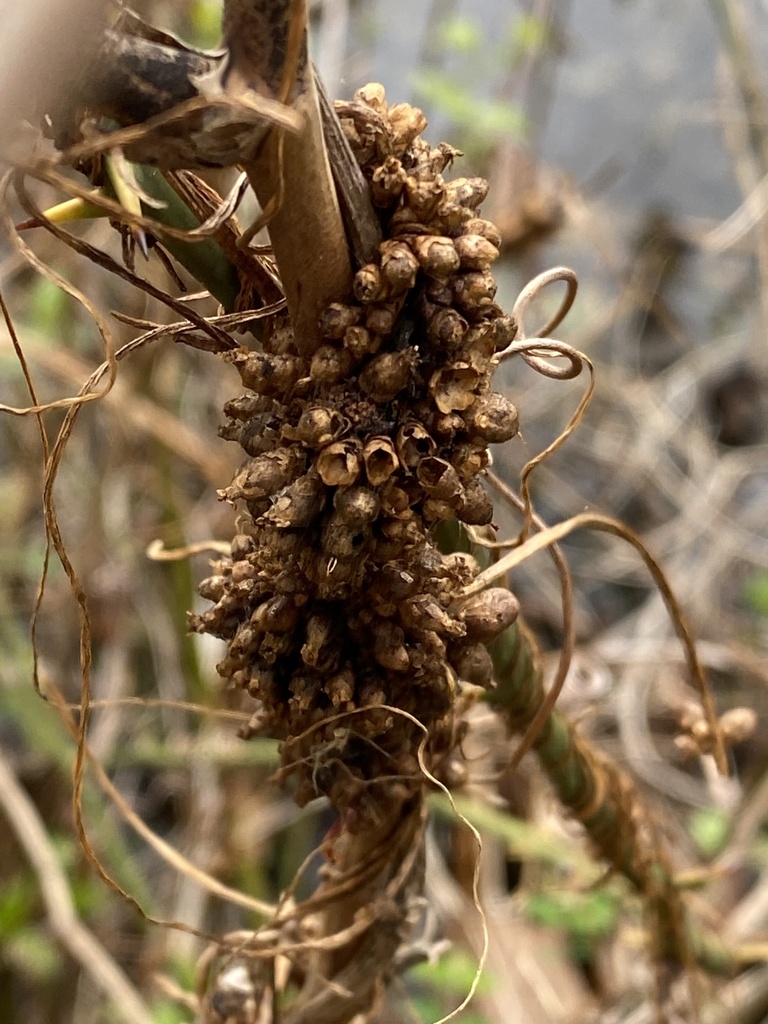
Quick facts
- Family: Convolvulaceae
- Difficulty: Demanding
- Watering: every 7 days
- Light: Partial shade
- Temperature: 10–30 °C
- Toxicity: Toxic to pets
About Compact dodder
Cuscuta compacta, also known as 'sessile dodder', is an annual parasitic plant characterized by its thin, filamentous yellow or orange stems, which lack leaves and roots. It twines around host plants, from which it extracts nutrients through haustoria. It is not a typical ornamental plant but rather of botanical interest due to its parasitic lifestyle.
Native range
North America (United States, Mexico)
Care tips
As a parasitic plant, Cuscuta compacta is not 'cultivated' in the traditional sense. Its care involves managing the host plants it grows on. If you wish to study it, it must be introduced into an environment with a suitable host plant, such as certain shrub or herbaceous species, to which it will attach and from which it will obtain everything it needs. It does not require its own watering or substrate, and the most common mistake is to try to grow it as an independent plant.
How to save a dying Compact dodder
- Warning signs
- Dry, brittle, or wilted stems; lack of growth or discoloration on the host. Cuscuta is a parasite, its health depends on the host plant.
- First aid
- Ensure the host is healthy and well-cared for (watering, light, nutrients). If Cuscuta is dry, remove dead parts. Sometimes, a host change can revive it if the current one is weak.
- What kills it
- A sick or dead host; lack of connection to the host. Not having a suitable host quickly weakens it. Over-fertilizing that burns the host's roots.
- Can it be saved?
- Yes, if its host can be saved. If the host dies, Cuscuta will die. If very weakened, it might not recover even if the host improves.