Flax dodder (Cuscuta epilinum)
Care, watering, light and tips for Flax dodder on Floravia.
Quick facts
- Family: Convolvulaceae
- Difficulty: Demanding
- Watering: every 7 days
- Light: Partial shade
- Temperature: 10–30 °C
- Toxicity: Toxic to pets
About Flax dodder
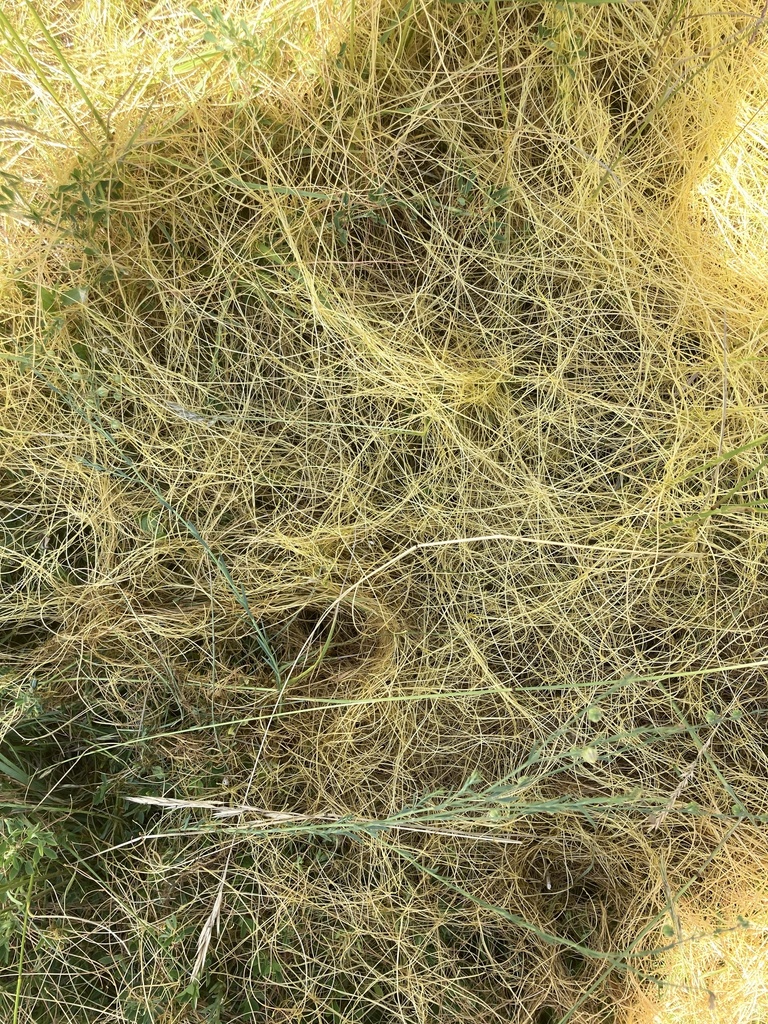
Cuscuta epilinum, also known as flax dodder, is an annual parasitic plant that lacks its own leaves and roots. It appears as thin, filamentous, yellow to reddish stems that twine around its host plant, from which it extracts nutrients. It is not an ornamental garden plant, but rather a species of botanical interest due to its peculiar parasitic lifestyle.
Native range
Europe and temperate Asia
Care tips
As an obligate parasitic plant, Cuscuta epilinum is not cultivated in the traditional sense. Its 'care' involves the presence of a suitable host plant, such as flax, from which it can obtain its resources. It does not require its own watering or substrate, as it is entirely dependent on its host. The most common mistake would be to attempt to grow it independently, as it cannot survive without parasitizing another plant.
How to save a dying Flax dodder
- Warning signs
- Pale, dry filaments, or not clinging to the host. Host shows signs of weakening or death.
- First aid
- Immediately remove all Cuscuta filaments from the host and surrounding area. Burn or dispose of the parasitic plant to prevent spread. Monitor the host.
- What kills it
- Failing to act quickly upon detection. Cuscuta is a parasite that rapidly depletes and kills its host if not controlled.
- Can it be saved?
- Cuscuta itself cannot be saved once the host dies or is removed; its purpose is to parasitize. The host can be saved if removed in time.