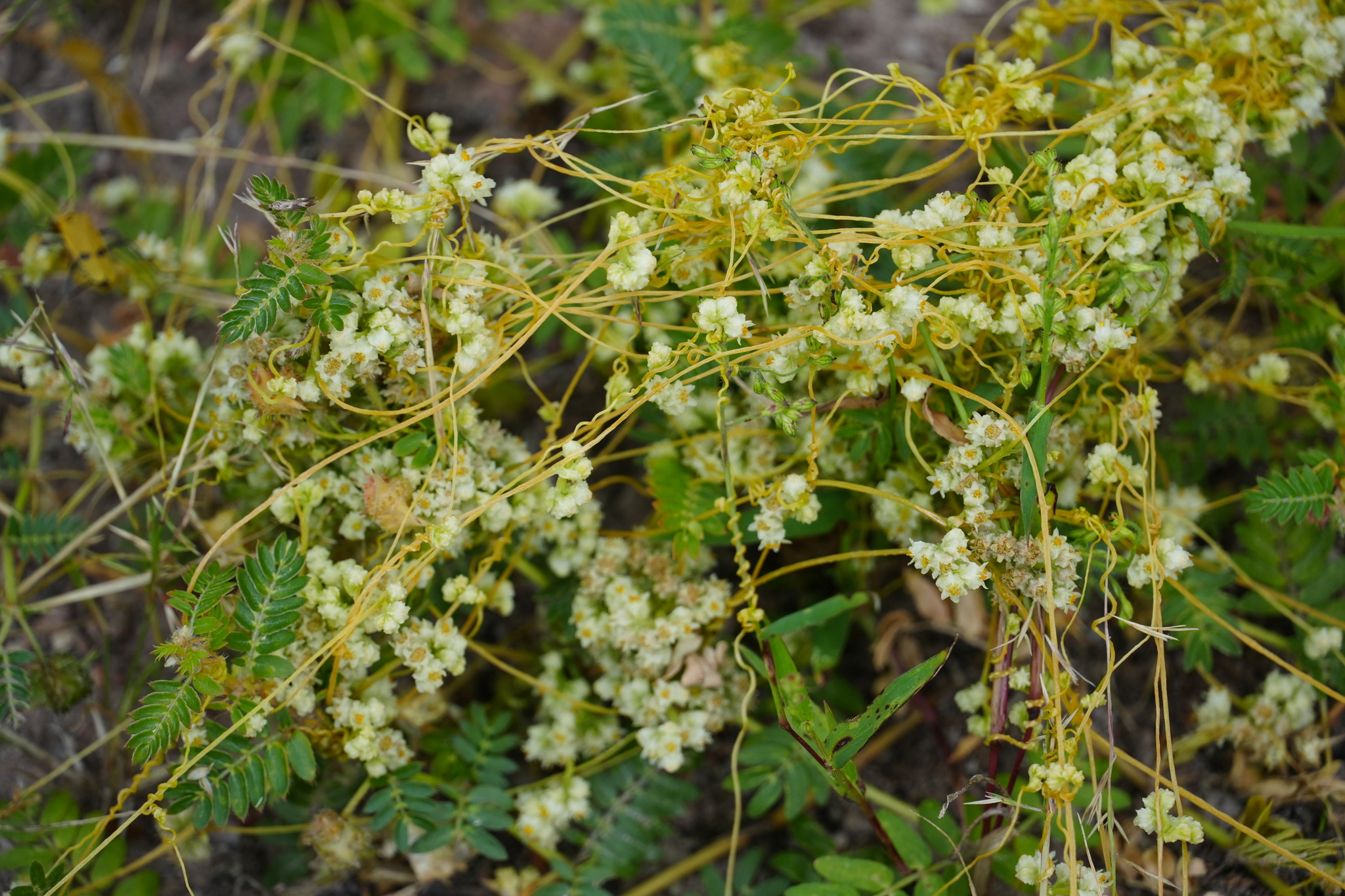
Tangled dodder (Cuscuta applanata)
Care, watering, light and tips for Tangled dodder on Floravia.
Quick facts
- Family: Convolvulaceae
- Difficulty: Demanding
- Watering: every 7 days
- Light: Partial shade
- Temperature: 10–30 °C
- Toxicity: Toxic to pets
About Tangled dodder
Cuscuta applanata, also known as Gila River dodder, is an annual parasitic plant that appears as a tangled mass of slender, leafless, yellow to reddish-orange stems. It lacks chlorophyll and relies entirely on its host plants for sustenance. This is not an ornamental plant for cultivation in gardens or indoors.
Native range
Southwestern United States and northern Mexico
Care tips
As Cuscuta applanata is a parasitic plant that feeds on other species, it is not intentionally cultivated. Its presence is considered a pest in agriculture and gardening, as it weakens and can kill its hosts. Control involves early manual removal of infested plants or the use of specific herbicides before the dodder establishes a connection. The common mistake to avoid is allowing it to spread, as its seeds can remain viable in the soil for years.
How to save a dying Tangled dodder
- Warning signs
- Dry, brittle, whitish or blackened filaments. Loss of its reddish/orange color.
- First aid
- Remove dead parts. If the host is affected, check it. Ensure it has a live, healthy host plant.
- What kills it
- Not finding a suitable host or host dying. Excessive pesticides near the host.
- Can it be saved?
- Yes, if live parts and a host are available. Cuscuta is parasitic; its life depends on another plant.