Cuscuta tuberculata
Care, watering, light and tips for Cuscuta tuberculata on Floravia.
Quick facts
- Family: Convolvulaceae
- Difficulty: Demanding
- Watering: every 7 days
- Light: Partial shade
- Temperature: 10–30 °C
- Toxicity: Toxic to pets
About Cuscuta tuberculata
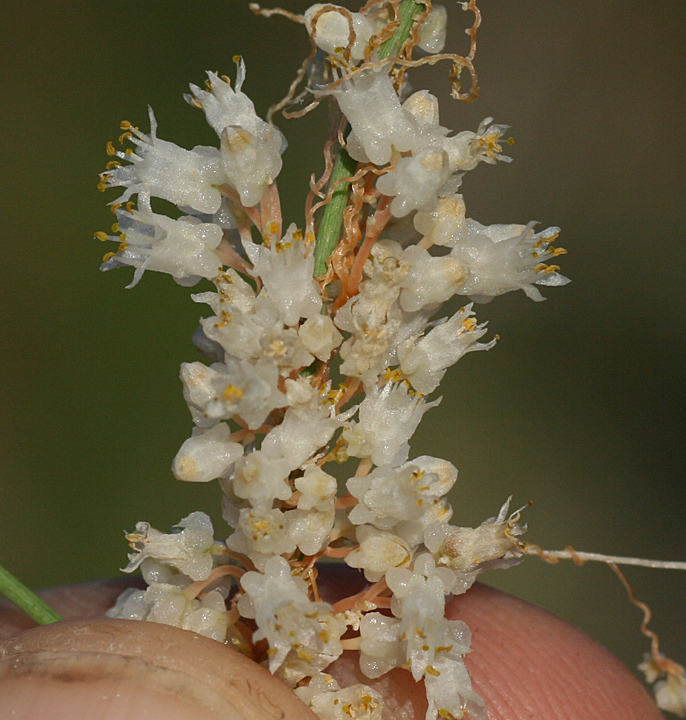
Cuscuta tuberculata, commonly known as Desert Dodder, is an annual parasitic plant native to arid regions of North America. It appears as a tangle of slender, leafless, yellow or orange stems that coil around other plants to extract nutrients. It is an interesting plant for botanical studies or for those interested in desert ecosystems, but it is not suitable as an ornamental garden plant due to its parasitic nature.
Native range
Southwestern United States and northern Mexico
Care tips
As an obligate parasitic plant, Cuscuta tuberculata is not cultivated in the traditional sense. Its survival depends on finding a suitable host from which to extract water and nutrients. It does not require watering or substrate, as its roots atrophy after the haustoria establish on the host plant. The most common mistake would be to try and cultivate it independently, as without a host, the plant cannot survive.
How to save a dying Cuscuta tuberculata
- Warning signs
- Yellowish or orange filaments losing vitality, drying out, becoming brittle, and detaching from the host plant.
- First aid
- Manually remove all visible Cuscuta filaments from the host plant and dispose of them far away. Ensure no fragments are left to regrow.
- What kills it
- Mistaking it for another species and not acting quickly, allowing it to continue parasitizing and severely weakening its host until death.
- Can it be saved?
- Yes, if the Cuscuta is completely and timely removed. The host plant will recover if not irreversibly damaged.