Cuscuta leptantha
Care, watering, light and tips for Cuscuta leptantha on Floravia.
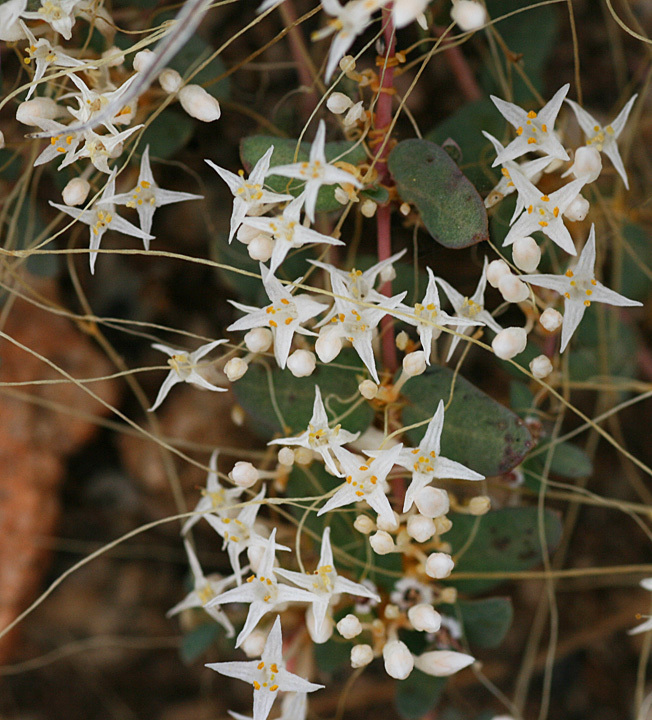
Quick facts
- Family: Convolvulaceae
- Difficulty: Demanding
- Watering: every 7 days
- Light: Partial shade
- Temperature: 10–30 °C
- Toxicity: Toxic to pets
About Cuscuta leptantha
Cuscuta leptantha, commonly known as 'Slender dodder', is an annual parasitic plant lacking chlorophyll, distinguished by its thin, reddish or yellowish stems that form a tangled mass over its host. It has no leaves or roots of its own, obtaining all its nutrients from the plant it attaches to via haustoria. It is not an ornamental plant to be cultivated on its own, but rather a weed that can affect crops and wild plants.
Native range
Native to Southern Africa
Care tips
As Cuscuta leptantha is a parasitic plant, its 'care' focuses on control and prevention. The best strategy is to prevent its appearance by using certified Cuscuta-free seeds and cleaning tools. If already present, manual removal is effective before it produces seeds, by cutting the host stems below the Cuscuta's attachment point. The use of specific herbicides may be necessary in severe infestations, but always with caution to avoid harming the host. A common mistake is to try to 'cultivate' it or expect it to thrive without a host, which is impossible.
How to save a dying Cuscuta leptantha
- Warning signs
- Dry, brittle stems, lacking characteristic reddish or yellowish vitality. Loss of adhesion to the host plant.
- First aid
- Identify and change host plant if it's weak. Ensure good indirect light and high humidity. Water host's base if environment is dry.
- What kills it
- Lack of suitable host, extreme environmental or host plant dryness. Excessive direct sun burning it.
- Can it be saved?
- Yes, if there are live, flexible stems. It needs a strong host and correct environmental conditions to re-parasitize.