Western dodder (Cuscuta occidentalis)
Care, watering, light and tips for Western dodder on Floravia.
Quick facts
- Family: Convolvulaceae
- Difficulty: Demanding
- Watering: every 7 days
- Light: Partial shade
- Temperature: 10–30 °C
- Toxicity: Toxic to pets
About Western dodder
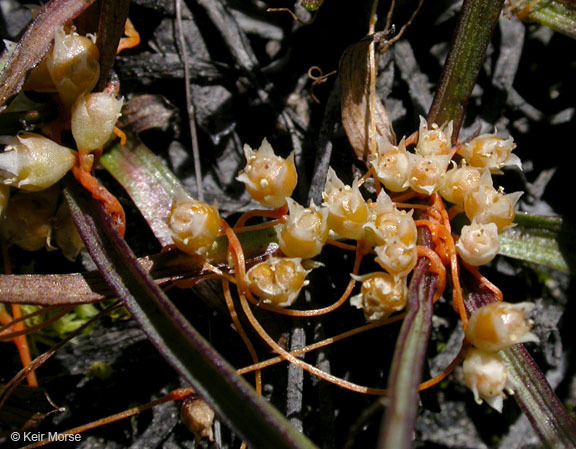
Cuscuta occidentalis, commonly known as 'Western Dodder', is an annual, chlorophyll-lacking parasitic plant that forms filamentous, yellow, orange, or reddish vines. Its slender stems coil around host plants, from which it extracts nutrients via haustoria. It is not an ornamental plant and is generally considered a weed in agricultural and natural settings.
Native range
Western North America
Care tips
As a parasitic plant, Cuscuta occidentalis is not intentionally cultivated, and its 'care' focuses on eradication. To control it, it is crucial to remove it manually or with herbicides before it produces seeds, ensuring all stem fragments are removed. It requires no watering or substrate, as it is entirely dependent on its host plant for survival. A common mistake is underestimating its ability to regrow from small stem fragments.
How to save a dying Western dodder
- Warning signs
- Dry, brittle, or pale/yellowish filaments. No new growth or attachment to its host.
- First aid
- Identify and remove severely damaged host. If possible, transfer dodder to a new, healthy host. Ensure good light and humidity.
- What kills it
- Failure to find a suitable host in time, or host death. Systemic herbicide application.
- Can it be saved?
- Yes, if acted upon quickly and a new host is provided. Its regrowth capacity is limited without a host.