Pacific dodder (Cuscuta pacifica)
Care, watering, light and tips for Pacific dodder on Floravia.
Quick facts
- Family: Convolvulaceae
- Difficulty: Demanding
- Watering: every 7 days
- Light: Partial shade
- Temperature: 10–30 °C
About Pacific dodder
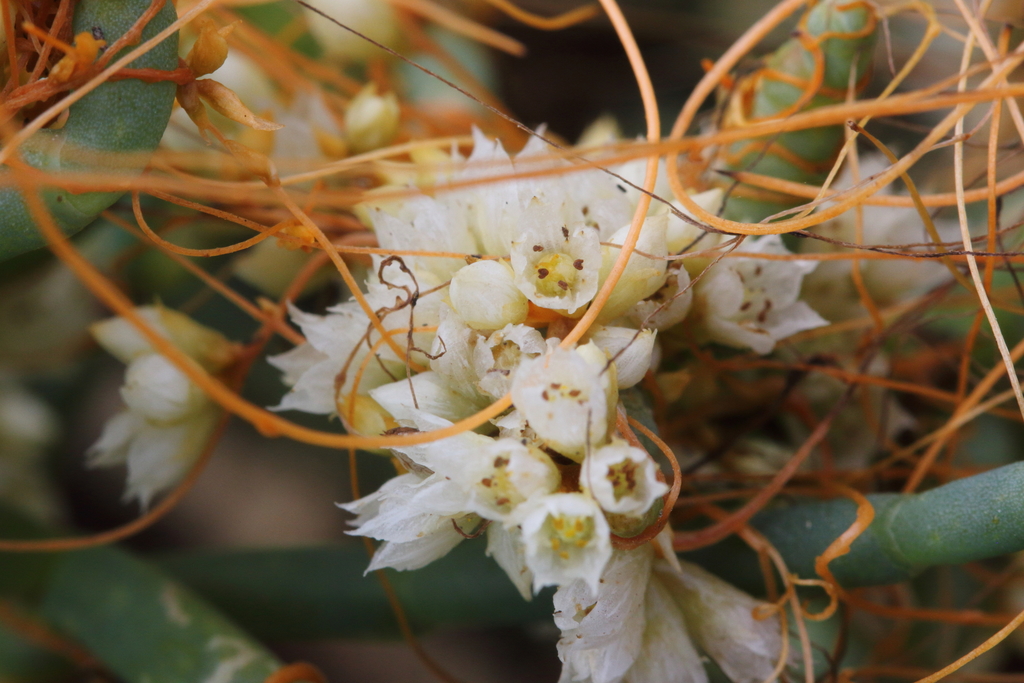
Cuscuta pacifica, commonly known as 'large saltmarsh dodder', is an annual parasitic plant native to the salt marshes of western North America. It lacks leaves and roots, featuring slender, filamentous, yellow to orange stems that entwine around host plants. While a fascinating plant in its ecological niche, it is not cultivated as an ornamental due to its parasitic nature and impact on host vegetation.
Native range
Coasts of North America, from southwestern Canada to Mexico
Care tips
This species is an obligate parasite of other plants, primarily salt marsh vegetation, and therefore is not cultivated in gardens or as an indoor plant. It does not require watering or substrate in the traditional sense, as it obtains all its nutrients and water from the host plant. The most common mistake to avoid would be attempting to cultivate it independently, as without a suitable host, it cannot survive.
How to save a dying Pacific dodder
- Warning signs
- Pale yellow or whitish discoloration, generalized wilting, loss of turgor in stems.
- First aid
- Move to partial shade, reduce watering. Check for dry or absent hosts.
- What kills it
- Prolonged direct sun, lack of suitable host, or overwatering in heavy soils.
- Can it be saved?
- Yes, if you act fast. A change of location and a live host can revive it.