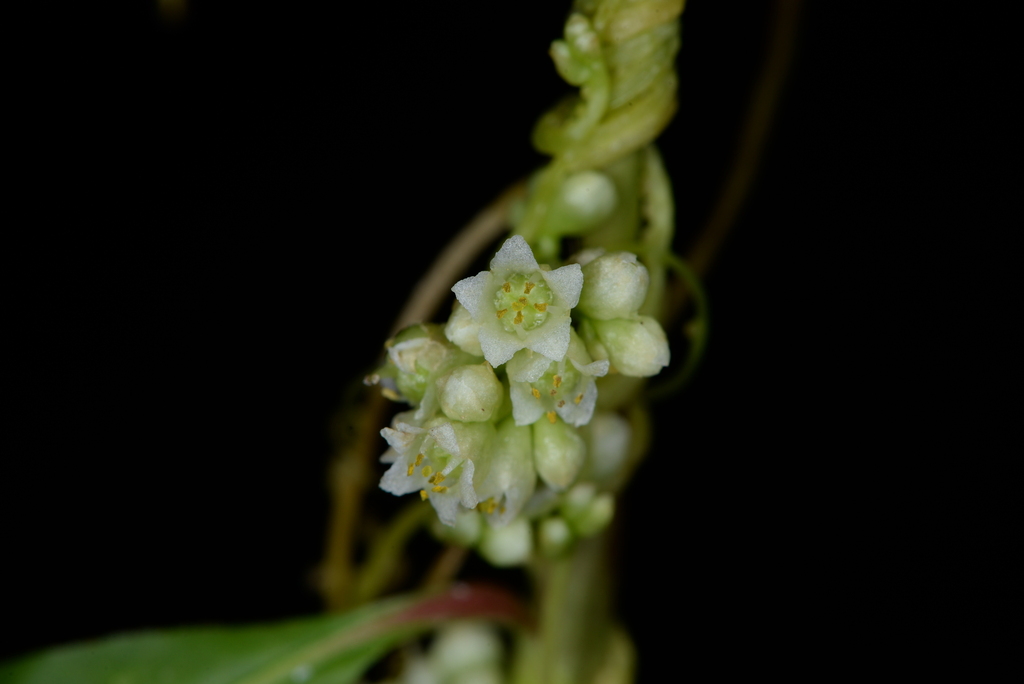
Australian dodder (Cuscuta australis)
Care, watering, light and tips for Australian dodder on Floravia.
Quick facts
- Family: Convolvulaceae
- Difficulty: Demanding
- Watering: every 7 days
- Light: Partial shade
- Temperature: 10–30 °C
- Toxicity: Toxic to pets
About Australian dodder
Cuscuta australis, commonly known as 'Australian Dodder', is an annual, chlorophyll-free parasitic plant that forms tangled masses of thin, yellow or orange stems. It attaches to its host plants using haustoria, extracting nutrients. While not a typical ornamental plant, its intertwined growth can be of interest in botanical studies or to illustrate ecological relationships.
Native range
Australia and New Zealand
Care tips
Caring for Cuscuta australis is unique, as it is a parasitic plant. It is not grown in conventional pots but requires a vigorous host plant to survive, from which it will extract water and nutrients. 'Light' and 'watering' are indirectly provided by the host plant. A common mistake would be to attempt to cultivate it independently, as without a host, Cuscuta australis cannot develop.
How to save a dying Australian dodder
- Warning signs
- Weak, pale, thin stems, lack of host attachment. Cuscuta weakens if it doesn't find a suitable host or if the host is sick.
- First aid
- Transfer it to a young, vigorous host, ideally legumes or solanaceous plants. Ensure the host is healthy and pest-free. Prune dying sections.
- What kills it
- Failing to find a suitable host quickly. Cuscuta is an obligate parasite; without a plant to anchor its haustoria, it will starve. Overuse of nearby herbicides.
- Can it be saved?
- Yes, if you act quickly and transfer it to a compatible, healthy host before its reserves are completely depleted. Speed is crucial.