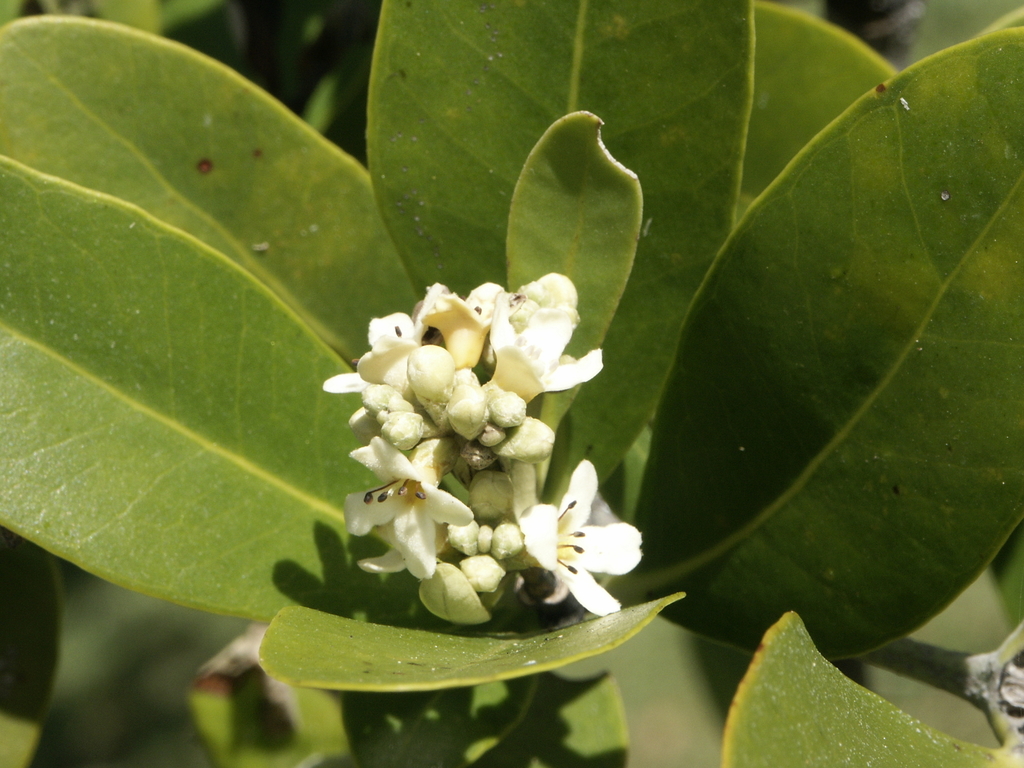
Black mangrove (Avicennia germinans)
Care, watering, light and tips for Black mangrove on Floravia.
Quick facts
- Family: Acanthaceae
- Difficulty: Demanding
- Watering: every 7 days
- Light: Partial shade
- Temperature: 10–30 °C
- Toxicity: Toxic to pets
About Black mangrove
The black mangrove (Avicennia germinans) is a halophytic tree or shrub crucial for tropical and subtropical coastal ecosystems. It is characterized by its specialized aerial roots (pneumatophores) protruding from the soil and its glossy, bright green foliage, often covered with excreted salt crystals. It is ideal for mangrove restoration projects, coastal gardens in suitable climates, or as an educational specimen in botanical collections.
Native range
Tropical and subtropical coasts of the Americas, including the southern United States, Mexico, Central America, the Caribbean, and northern South America, as well as the west coast of Africa.
Care tips
It requires full sun and waterlogged or flooded soils with brackish or saline water, as it is a species adapted to intertidal conditions. Watering should mimic its natural habitat, keeping it consistently moist or submerged in saline water. The ideal substrate is a mixture of sand, silt, and clay, typical of estuaries and coastlines. A common mistake is attempting to grow it in fresh water or in non-saline soils, as this will compromise its health and survival.
How to save a dying Black mangrove
- Warning signs
- Yellow or dropping leaves, soft stems, lack of growth in a saline environment.
- First aid
- Check water salinity (ideal 10-30 ppt) and root aeration. Ensure drainage.
- What kills it
- Constant fresh water or insufficient salinity. Excess organic matter in substrate.
- Can it be saved?
- Yes, if salinity and substrate oxygenation are quickly corrected. Needs brackish environment.