Cobweb house-leek (Sempervivum arachnoideum)
Care, watering, light and tips for Cobweb house-leek on Floravia.
Quick facts
- Family: Crassulaceae
- Difficulty: Easy to care for
- Watering: every 14 days
- Light: Full sun
- Temperature: 5–35 °C
About Cobweb house-leek
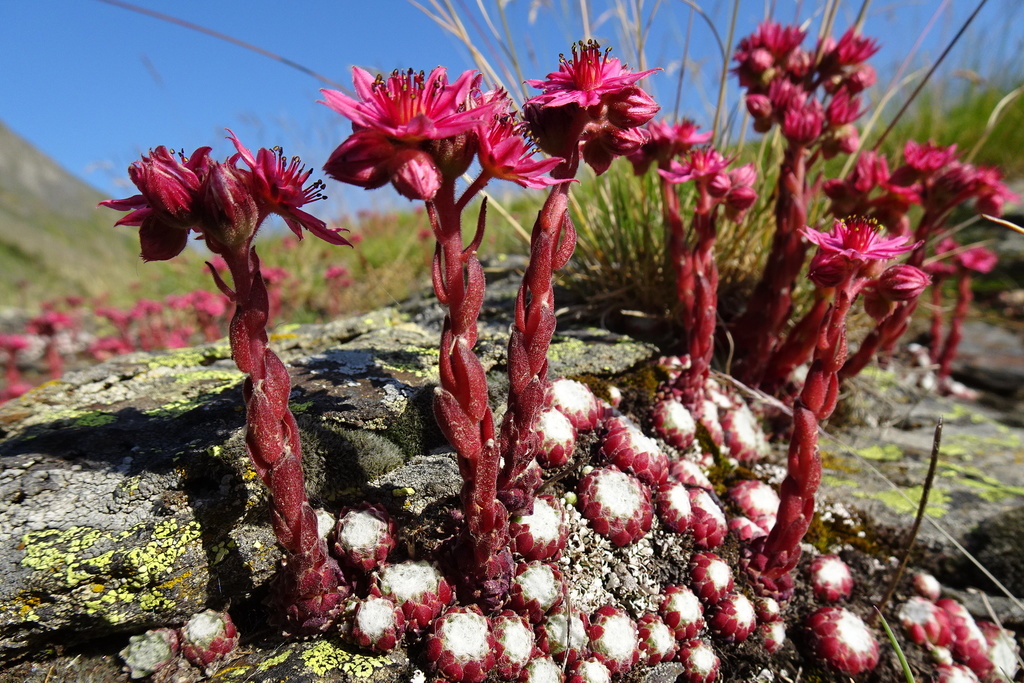
Sempervivum arachnoideum, also known as "Cobweb Houseleek" due to its unique appearance, is a low-growing perennial succulent that forms compact rosettes. Its fleshy green to reddish leaves are covered with fine white hairs resembling a cobweb, especially in the center of the rosette. It's ideal for rock gardens, green roofs, containers, or as part of succulent arrangements, adding a textured and distinctive touch.
Native range
Mountains of Central and Southern Europe (Alps, Pyrenees, Carpathians)
Care tips
This succulent thrives in full sun to maintain its intense coloration and compact form; it tolerates some partial shade. Watering should be sparse, allowing the substrate to dry out completely between waterings to prevent rot, especially in winter. It requires a very well-drained, sandy, or succulent-specific substrate. A common mistake to avoid is overwatering, which can be fatal to the plant.
How to save a dying Cobweb house-leek
- Warning signs
- Soft, translucent, or blackening leaves (overwatering). Wrinkled, dry leaves (underwatering/extreme sun).
- First aid
- Remove damaged leaves. Check roots: prune if soft. If dry, hydrate without waterlogging. Repot to well-draining soil.
- What kills it
- Overwatering is its biggest enemy, rotting roots. Also, poor draining soil or total shade.
- Can it be saved?
- Yes! They are very resilient. Act quickly at signs of severe rot or dehydration.