Prickly saltwort (Salsola kali)
Care, watering, light and tips for Prickly saltwort on Floravia.
Quick facts
- Family: Amaranthaceae
- Difficulty: Easy to care for
- Watering: every 14 days
- Light: Partial shade
- Temperature: 10–30 °C
- Toxicity: Toxic to pets
About Prickly saltwort
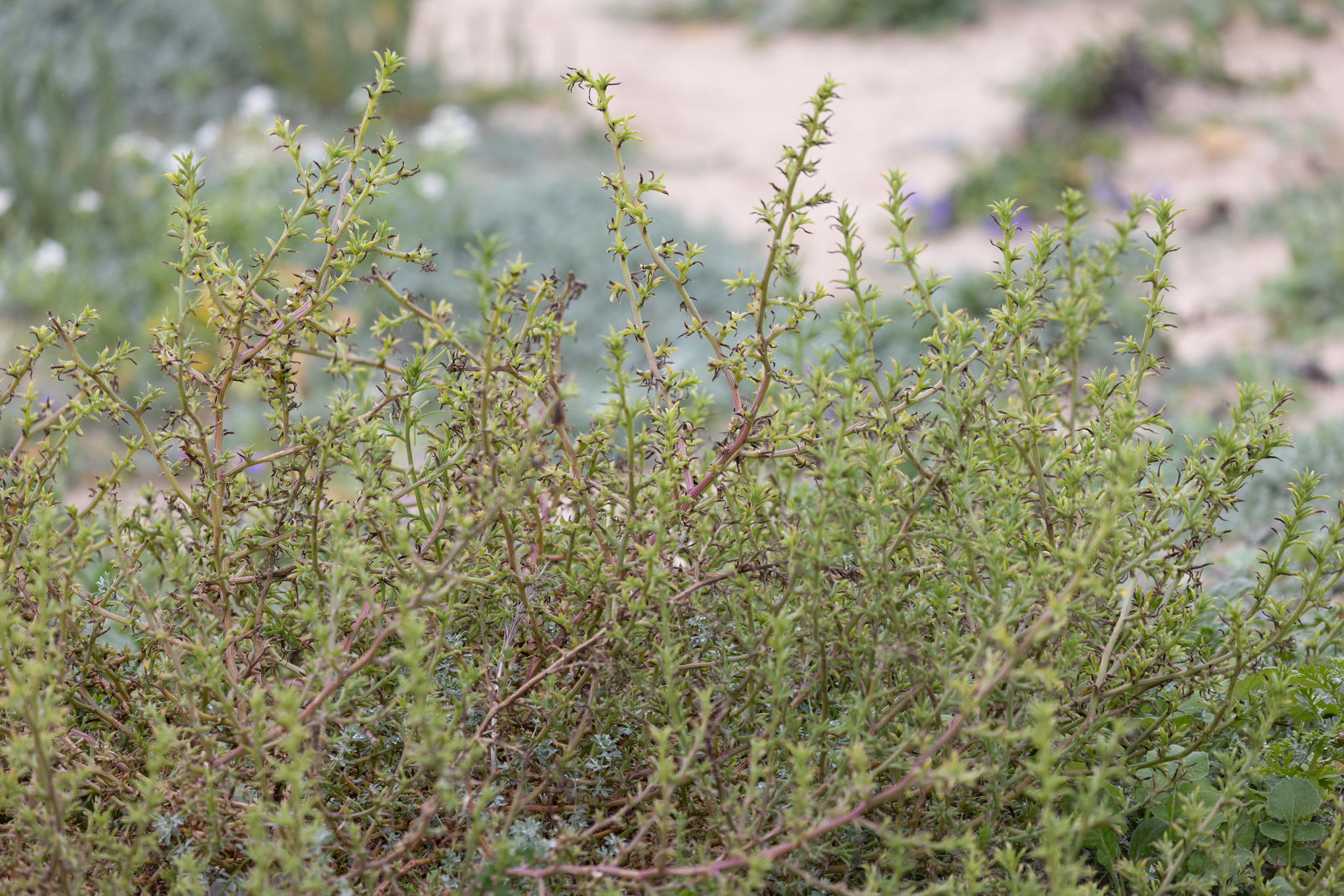
Salsola kali, commonly known as prickly saltwort or Russian thistle (stekend loogkruid and zacht loogkruid in Dutch), is an annual halophytic plant that forms globular, spiny clumps. Its branched stems and succulent leaves make it resilient to arid and saline conditions, and its spherical shape at maturity turns it into a 'tumbleweed' that disperses its seeds with the wind. It is ideal for xeriscape or coastal gardens, where its hardiness and unique form can be appreciated.
Native range
Europe, Asia, and North Africa
Care tips
This plant thrives in full sun and tolerates poor, sandy, or saline soils, with no need for fertilization. Watering should be minimal once established, as it is extremely drought-tolerant and overwatering will harm it. It does not require special substrate, adapting well to challenging conditions. The common mistake to avoid is overwatering, which can lead to root rot.
How to save a dying Prickly saltwort
- Warning signs
- Soft, blackened stems; yellowing or easily shedding dry leaves.
- First aid
- Remove affected parts, reduce watering, ensure good drainage. Move to a sunny, well-ventilated spot.
- What kills it
- Overwatering and lack of direct sun. It's an arid environment plant.
- Can it be saved?
- Yes, if roots are not fully rotted and some firm stems remain.