Venus flytrap (Dionaea muscipula)
Care, watering, light and tips for Venus flytrap on Floravia.
Quick facts
- Family: Droseraceae
- Difficulty: Demanding
- Watering: every 2 days
- Light: Partial shade
- Temperature: 10–30 °C
About Venus flytrap
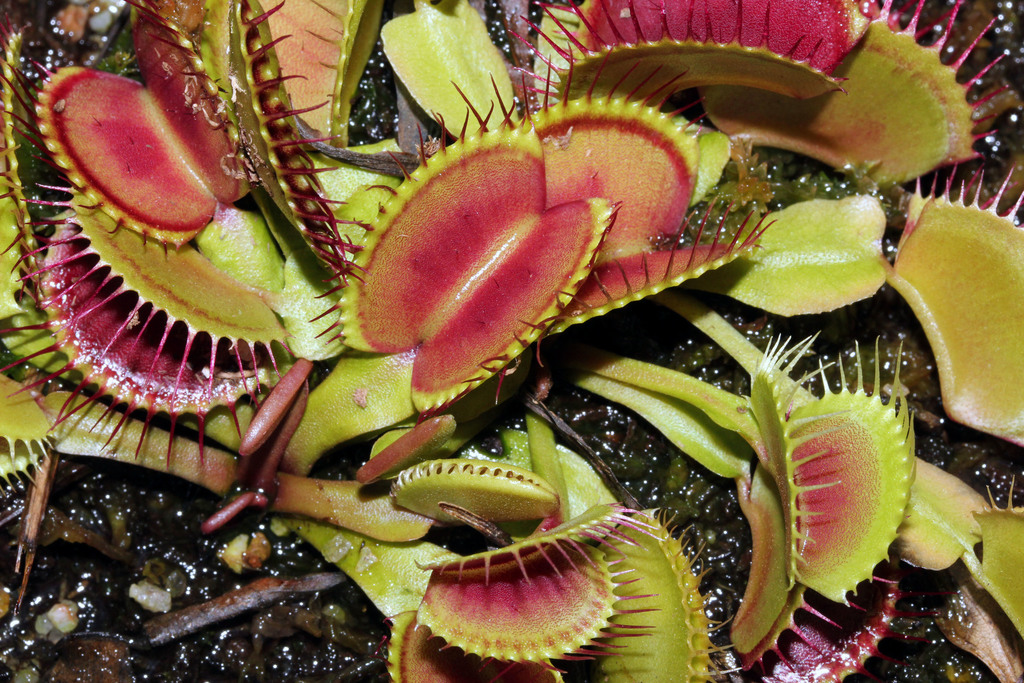
Dionaea muscipula, commonly known as the Venus Flytrap, is a fascinating carnivorous plant famous for its modified, trap-like leaves, which it uses to capture insects. Its reddish inner lobes and marginal cilia give it an exotic appearance, making it a spectacular addition to any terrarium or carnivorous plant collection, perfect for adding a unique touch to a desk or sunny windowsill.
Native range
Subtropical wetlands of North and South Carolina, United States.
Care tips
It requires at least 4-6 hours of direct sunlight daily to maintain active and colorful traps. Watering should be done with distilled, rainwater, or reverse osmosis water, keeping the substrate consistently moist using the tray method. Use a nutrient-poor substrate, such as a mix of sphagnum peat moss and perlite, and never fertilize or manually trigger the traps without real prey, as this weakens them.
How to save a dying Venus flytrap
- Warning signs
- Traps not closing, blackening from tips, soft or moldy leaves. Plant loses vigor and color.
- First aid
- Repot in a pot with drainage holes, using 50% peat moss (nutrient-free) and 50% perlite/silica sand. Water via tray with distilled water.
- What kills it
- Tap water (minerals), unsuitable (nutrient-rich) substrate, fertilizers, pots without drainage, lack of humidity, excessive handling.
- Can it be saved?
- Yes, if roots are still white and firm. Remove dead parts to prevent fungal spread.