Phelipanche arenaria
Care, watering, light and tips for Phelipanche arenaria on Floravia.
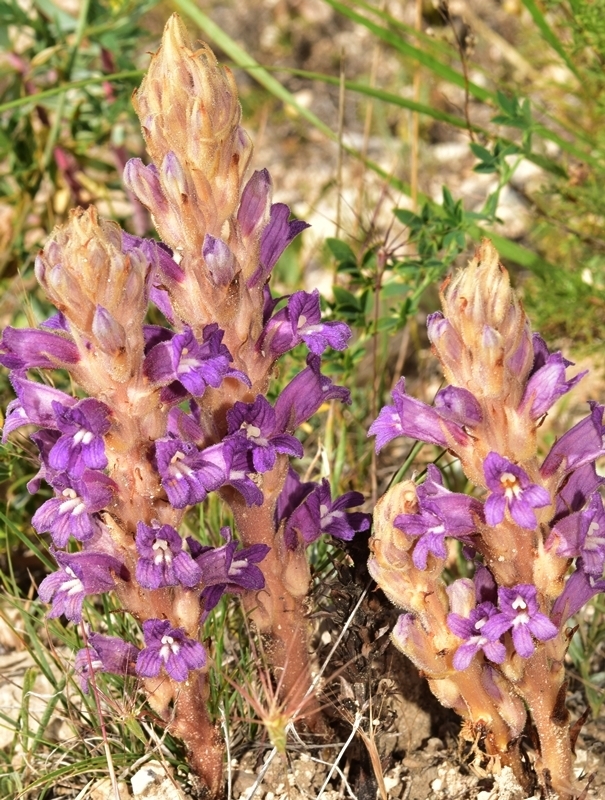
Quick facts
- Family: Orobanchaceae
- Difficulty: Demanding
- Watering: every 7 days
- Light: Partial shade
- Temperature: 10–30 °C
About Phelipanche arenaria
Phelipanche arenaria, also known as Sand Broomrape, is a parasitic herbaceous plant, lacking chlorophyll, that directly nourishes itself from the roots of other plants, particularly those of the genus Artemisia. It features erect, fleshy, yellowish to brownish stems, with tubular flowers clustered in dense spikes of purplish or yellowish hues. Due to its parasitic nature and dependence on a specific host, it is not an ornamental plant for garden or pot cultivation, but rather a species of ecological and botanical interest, found in sandy habitats and coastal dunes.
Native range
Central and Southern Europe, extending to West Asia and North Africa
Care tips
Since Phelipanche arenaria is an obligate parasitic plant and does not perform photosynthesis, it cannot be cultivated conventionally as an ornamental plant. Its survival depends entirely on the presence of a suitable host plant, such as Artemisia campestris or Artemisia maritima, to whose roots it attaches. Attempts to cultivate it without its host will be unsuccessful, as it lacks the ability to produce its own food. Therefore, watering, light, or substrate advice as for other plants do not apply, its management being rather a matter of conserving its natural habitat and host species.
How to save a dying Phelipanche arenaria
- Warning signs
- General wilting, lack of vigor, pale or brownish color. If no host plant is near, it's a problem.
- First aid
- Ensure it's parasitizing a suitable host plant (Artemisia campestris or similar). Relocate if needed.
- What kills it
- Trying to grow it as an independent plant without a host. Overwatering is also fatal.
- Can it be saved?
- Yes, if the correct host is identified and the environment is corrected in time.