Sunflower broomrape (Orobanche cumana)
Care, watering, light and tips for Sunflower broomrape on Floravia.
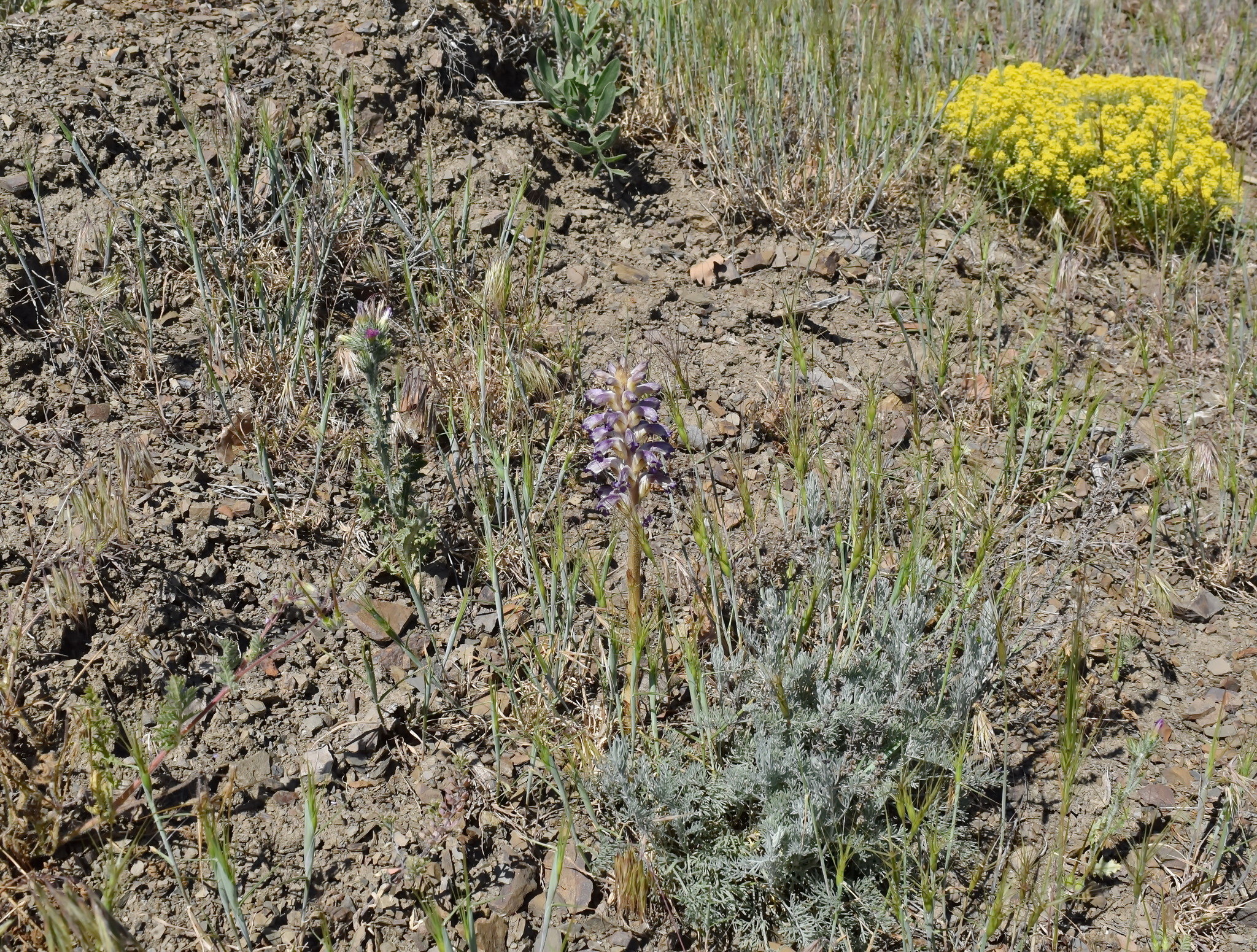
Quick facts
- Family: Orobanchaceae
- Difficulty: Demanding
- Watering: every 7 days
- Light: Partial shade
- Temperature: 10–30 °C
- Toxicity: Toxic to pets
About Sunflower broomrape
Orobanche cumana, commonly known as broomrape, is a parasitic plant lacking chlorophyll, meaning it does not perform photosynthesis. It is characterized by its fleshy, yellowish to purplish stems and dense spikes of tubular flowers. It is not an ornamental plant for gardens, but rather a species of botanical interest due to its parasitic ecology.
Native range
Eastern Europe, Central Asia, and the Caucasus
Care tips
As a parasitic plant, Orobanche cumana is not cultivated in the same way as autonomous plants. Its 'care' involves the presence of a suitable host plant, such as sunflowers or tobacco, from whose roots it extracts nutrients. It does not require direct light or watering itself, as it is entirely dependent on its host. The main mistake would be to attempt to grow it independently, as it is unfeasible without a host.
How to save a dying Sunflower broomrape
- Warning signs
- No direct symptoms, as it's a parasitic plant. Its presence is indicated by the sudden decline of the sunflower host: yellowing, wilting, stunted growth.
- First aid
- Orobanche cumana is not rescued. The goal is to remove it to save the sunflower host. Carefully dig up the sunflower and look for Orobanche attached to its roots. Remove it manually.
- What kills it
- The goal is not to kill it, but to prevent its occurrence. The mistake is not using resistant sunflower seeds or not rotating crops. Once established, it is very difficult to eradicate.
- Can it be saved?
- Orobanche cumana cannot be 'saved' or 'cured'. It is a pest. Salvation is for the sunflower host, by removing Orobanche or preventing its attack.