Orobanche calendulae
Care, watering, light and tips for Orobanche calendulae on Floravia.
Quick facts
- Family: Orobanchaceae
- Difficulty: Demanding
- Watering: every 7 days
- Light: Partial shade
- Temperature: 10–30 °C
- Toxicity: Toxic to pets
About Orobanche calendulae
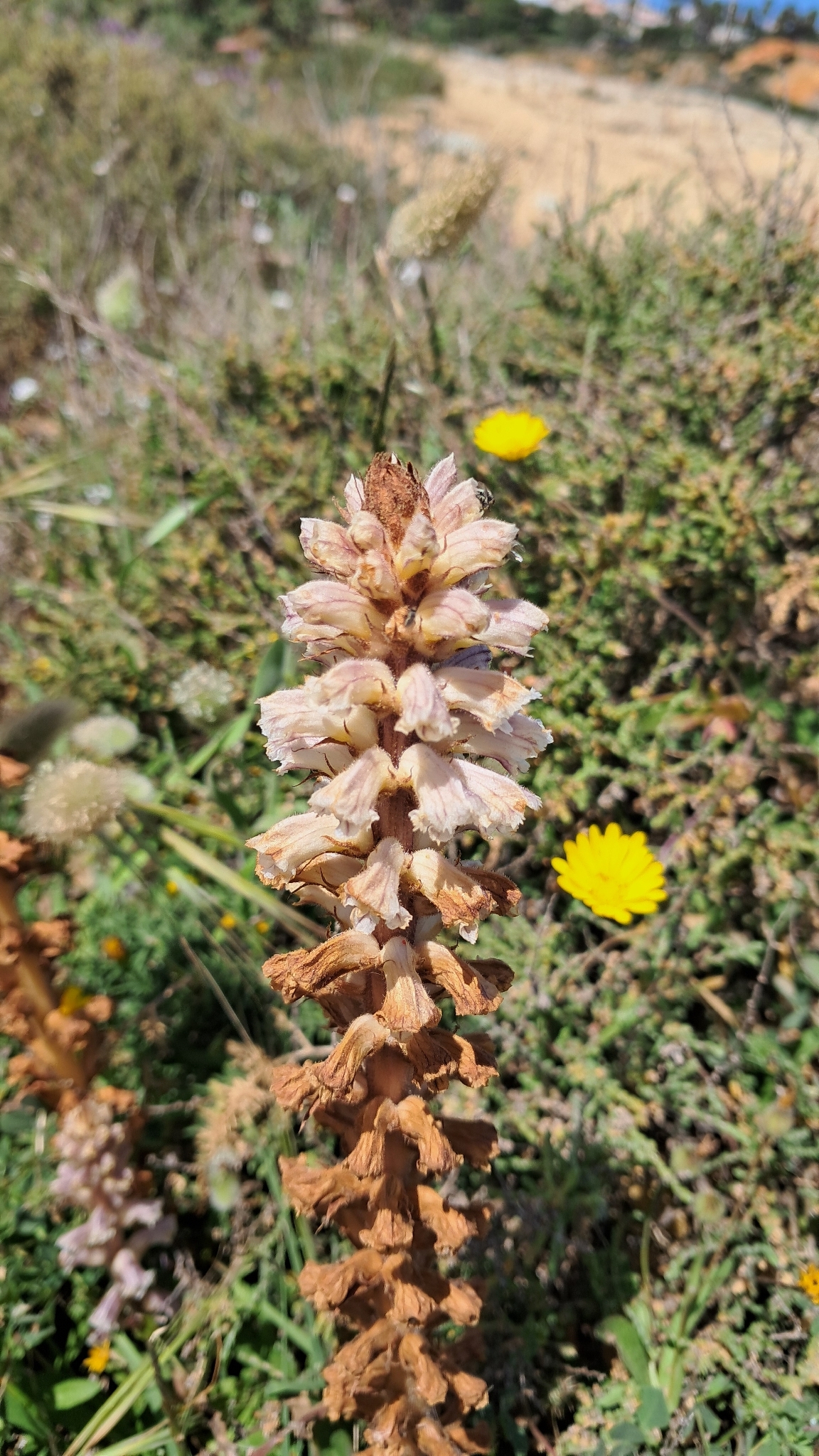
Orobanche calendulae, commonly known as calendula broomrape, is a parasitic plant lacking chlorophyll, which feeds directly from the roots of other plants, mainly those in the Asteraceae family like calendulas. It features fleshy, erect, scaly stems, ranging from yellowish to brownish, topped by a dense spike of tubular flowers. Due to its parasitic nature, it is not cultivated as an ornamental plant but is often found as a 'weed' in calendula crops or in habitats where its hosts thrive.
Native range
Mediterranean region and Middle East
Care tips
Caring for Orobanche calendulae is atypical, as its existence is entirely dependent on the presence of a suitable host plant, such as calendula. It does not require direct light or independent watering, as it obtains all its nutrients and water from the plant it parasitizes. The substrate must be suitable for its host, allowing for good root development. A common mistake is attempting to cultivate it independently, which is impossible due to its holoparasitic nature.
How to save a dying Orobanche calendulae
- Warning signs
- Widespread wilting, soft and blackened stems, lack of flowering or premature wilting of flowers.
- First aid
- Identify and remove the infected host plant to cut off its nutrient source. Isolate the area.
- What kills it
- Not acting quickly to remove the host. Systemic herbicides on the host are ineffective.
- Can it be saved?
- Very difficult, as it's parasitic. Prevention by controlling host weeds is key.