Cistanche phelypaea
Care, watering, light and tips for Cistanche phelypaea on Floravia.
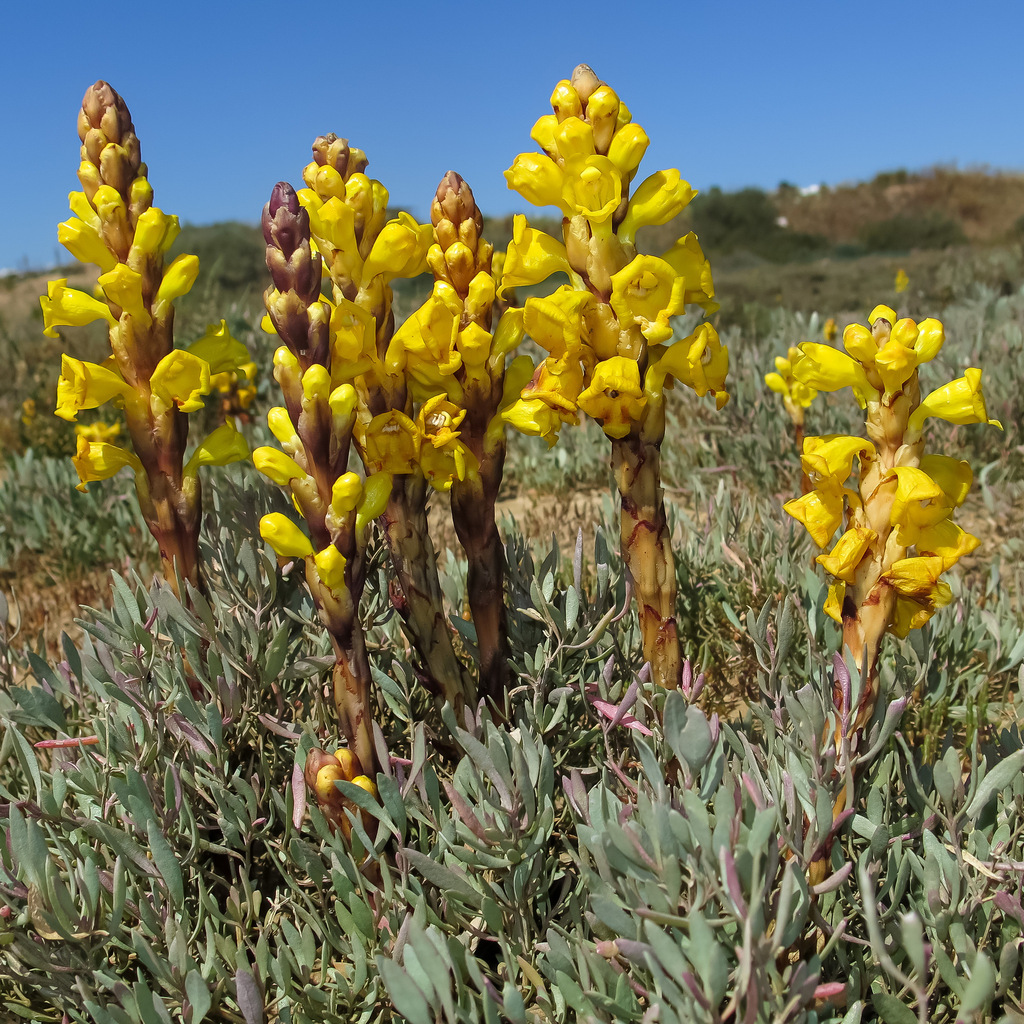
Quick facts
- Family: Orobanchaceae
- Difficulty: Demanding
- Watering: every 7 days
- Light: Partial shade
- Temperature: 10–30 °C
About Cistanche phelypaea
Cistanche phelypaea, commonly known as Cistanche, is a fascinating parasitic plant that lacks chlorophyll and is entirely dependent on other plants for its sustenance. It features fleshy, erect stems, ranging in color from yellowish to purple, emerging directly from the ground, often topped with dense spikes of tubular flowers. It's an intriguing species for collectors of rare plants or those interested in unusual botany, though indoor cultivation is complex due to its parasitic nature.
Native range
Mediterranean region, from the Iberian Peninsula to North Africa and the Middle East
Care tips
As a parasitic plant, Cistanche phelypaea is not cultivated directly but rather associated with the roots of specific host plants, such as certain Chenopodiaceae or Tamaricaceae, from which it obtains nutrients and water. Its 'care' primarily involves ensuring a suitable host and an environment similar to its natural habitat: sandy or saline soils and arid climates. Watering and sun exposure are managed for the host plant, not for the Cistanche itself, which will appear seasonally. A common mistake is attempting to grow it as an independent plant with normal substrate and watering, which is futile without a host.
How to save a dying Cistanche phelypaea
- Warning signs
- General wilting, lack of vigor, pale or brownish discoloration. As a parasite, its health reflects its host's.
- First aid
- Check the host plant's health. Ensure good drainage and avoid excess moisture. Protect from extreme cold.
- What kills it
- Destruction or disease of its host plant. Overwatering leading to root or rhizome rot.
- Can it be saved?
- Yes, if detected early and the host problem or excess moisture is corrected.