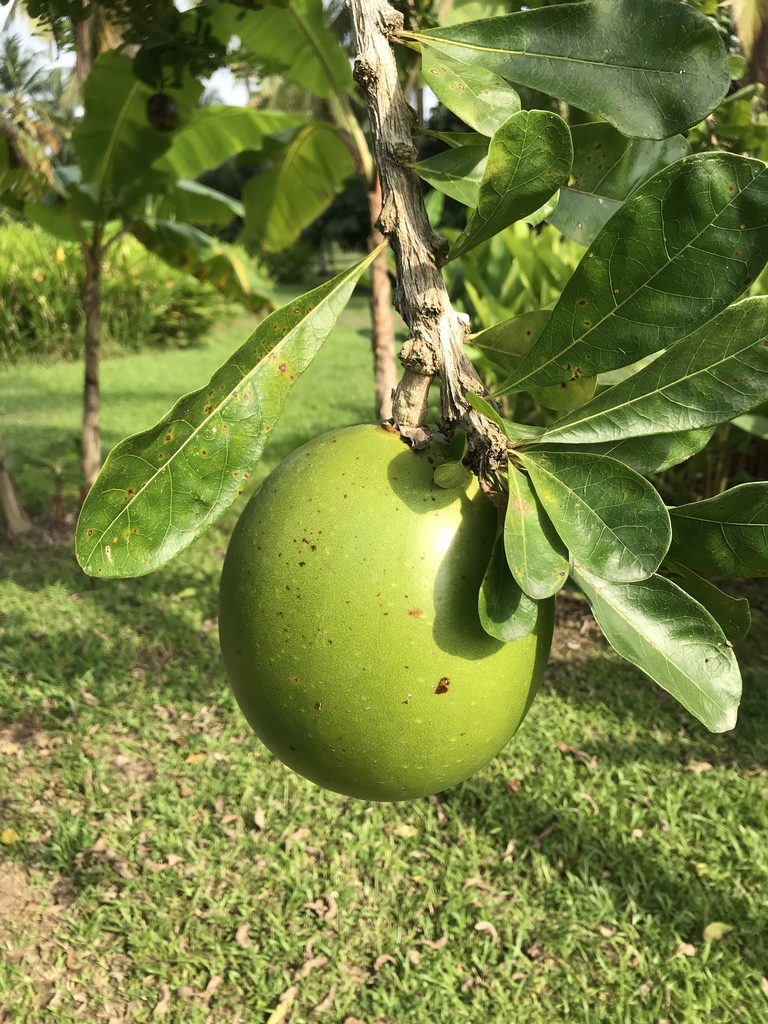
Calabash tree (Crescentia cujete)
Care, watering, light and tips for Calabash tree on Floravia.
Quick facts
- Family: Bignoniaceae
- Difficulty: Moderate care
- Watering: every 7 days
- Light: Partial shade
- Temperature: 10–30 °C
- Toxicity: Toxic to pets
About Calabash tree
The "Calabash Tree" (Crescentia cujete), also known as "hue kirikiri" in some cultures, is an evergreen tropical tree from the Bignoniaceae family, renowned for its large, round, gourd-like fruits that grow directly from the trunk and branches. Its dense, spreading canopy and glossy, simple leaves make it an ideal ornamental specimen for parks, large gardens, or as a shade tree in warm, humid climates. The dried fruits are traditionally used to craft containers, utensils, and handicrafts.
Native range
Tropical Americas, from southern Mexico to Brazil and the Antilles.
Care tips
It requires full sun for optimal growth and abundant fruiting, though it can tolerate partial shade in very hot climates. Watering should be regular and ample during the dry season, ensuring the soil remains moist but well-drained, and reduced during the rainy season. It prefers fertile, deep, and well-draining soils, tolerating a wide range of soil types as long as they are not waterlogged. A common mistake is planting it in locations with frost, as it is extremely sensitive to low temperatures and can die.
How to save a dying Calabash tree
- Warning signs
- Yellow or falling leaves, small/deformed fruits, soft/cracked trunk.
- First aid
- Check drainage/moisture, prune dry branches, apply fungicide if rot signs.
- What kills it
- Overwatering causing root rot, lack of direct sun, or poor soils.
- Can it be saved?
- Yes, if roots aren't completely rotted and it gets proper care promptly.