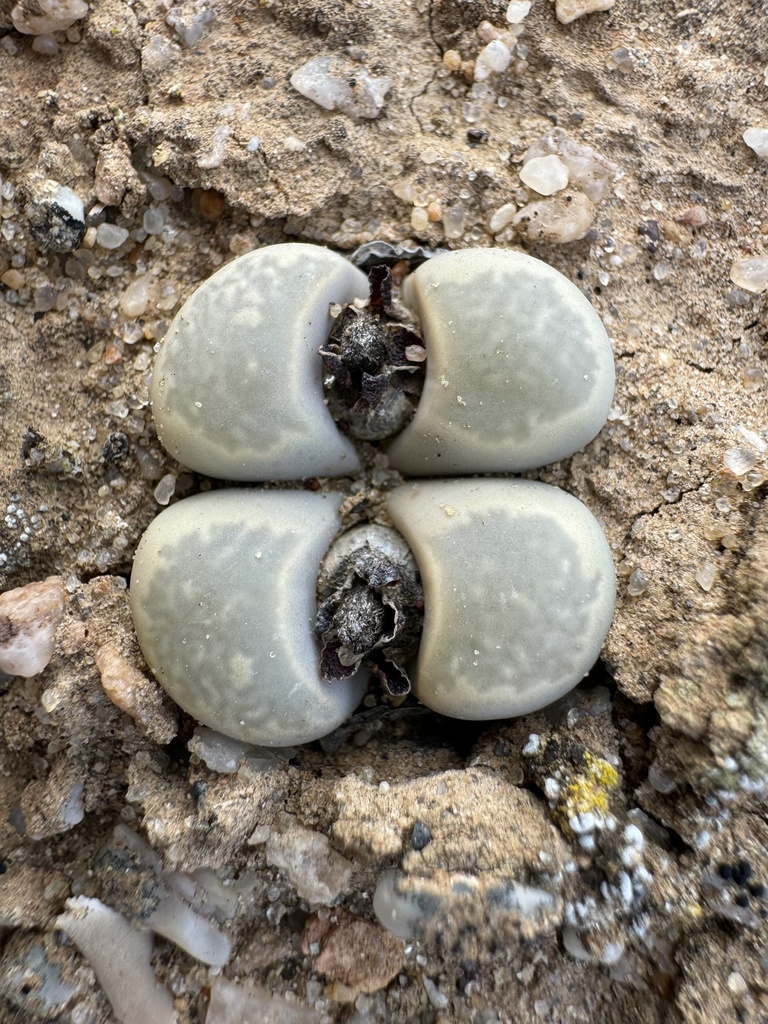
Living stones (Lithops herrei)
Care, watering, light and tips for Living stones on Floravia.
Quick facts
- Family: Aizoaceae
- Difficulty: Demanding
- Watering: every 21 days
- Light: Partial shade
- Temperature: 10–30 °C
About Living stones
Lithops herrei, also known as 'glasstenblad' or 'living stone', is a captivating succulent native to South Africa, mimicking the appearance of stones in its environment. Its bilobed, translucent bodies, with varied patterns and colors, make it perfect for succulent collections, desert terrariums, or as an accent plant in small pots. Its mimicry is so effective that it is often mistaken for pebbles in its natural habitat, adding a touch of curiosity and understated beauty to any space.
Native range
South Africa, specifically in the Northern Cape Province and the Karoo
Care tips
It requires intense direct sunlight for several hours a day to maintain its coloration and compact form, ideally on a sunny windowsill or under grow lights. Watering should be very sparse and seasonal: only when the old leaves are completely dry and new ones are emerging, and refrain from watering during winter and the shedding period. Use an extremely well-draining substrate, such as a specific Lithops or cactus mix with a high content of coarse sand, perlite, or pumice, to avoid waterlogging which is fatal. A common mistake is overwatering or watering out of season, which leads to plant rot.
How to save a dying Living stones
- Warning signs
- Excessive wrinkling or becoming soft. If soft and discolored, it's serious.
- First aid
- Remove from pot. Inspect roots. If rot, cut affected parts and air dry for several days.
- What kills it
- Overwatering, especially outside its active growth period (autumn/winter). Also, unsuitable substrate.
- Can it be saved?
- Yes, if caught early. Cutting rot and drying is key. Without rot, careful rehydration can help.