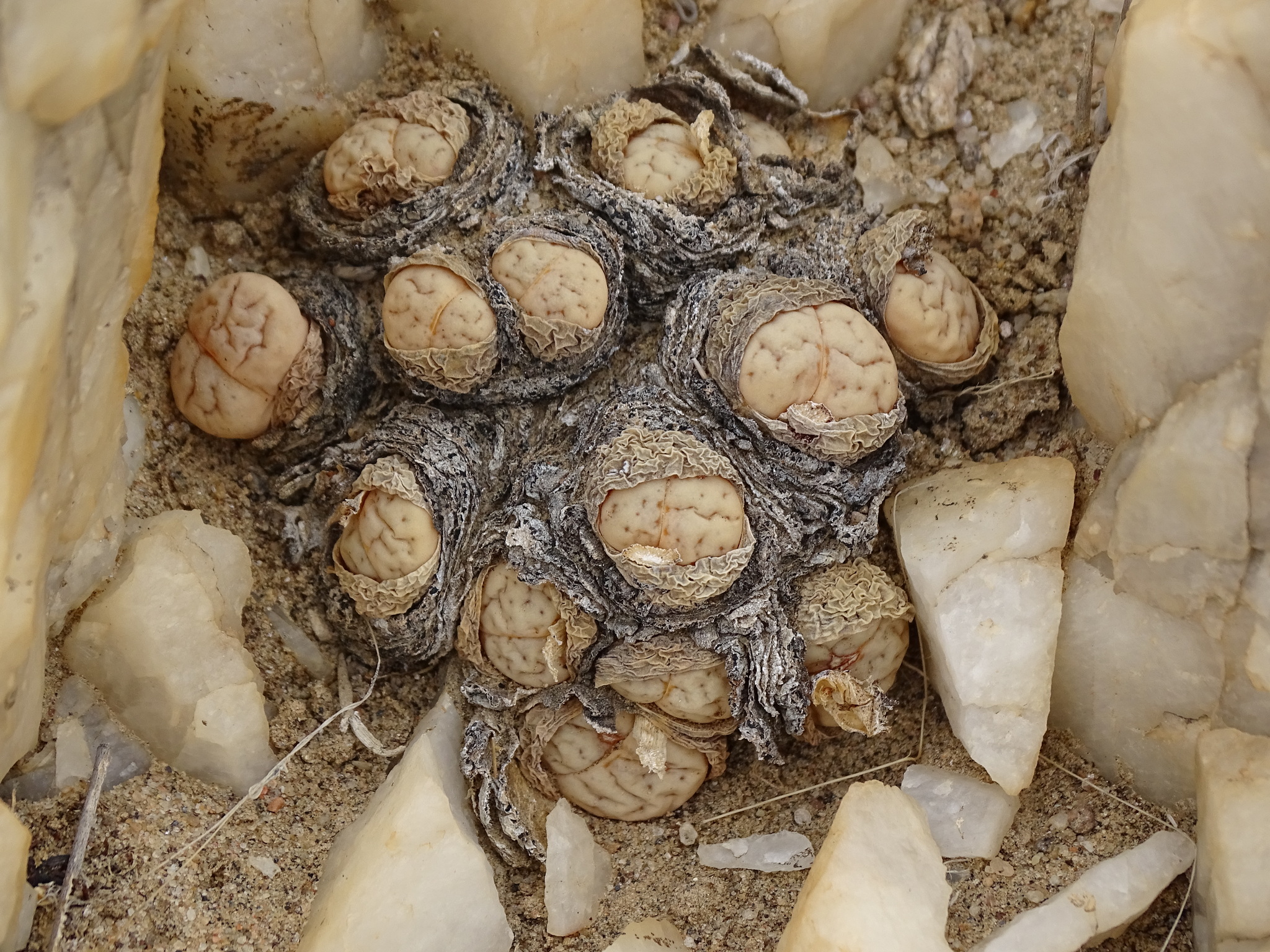
Living stones (Lithops ruschiorum)
Care, watering, light and tips for Living stones on Floravia.
Quick facts
- Family: Aizoaceae
- Difficulty: Demanding
- Watering: every 21 days
- Light: Partial shade
- Temperature: 10–30 °C
About Living stones
Lithops ruschiorum, commonly known as 'living stone', is a fascinating succulent from the Aizoaceae family, native to Namibia. Its two fused leaves form a conical body resembling a stone, with a central fissure and color patterns ranging from gray to brown, allowing it to perfectly camouflage in its desert environment. It is an ideal plant for desert terrariums, rock gardens, or as a unique decorative element in bright indoor spaces.
Native range
Southwestern Namibia
Care tips
It requires direct and intense sunlight for most of the day for optimal growth and vibrant coloration, avoiding shade. Watering should be extremely sparse and seasonal: water only when the old leaves are completely dry and new ones begin to emerge (typically in autumn and spring), avoiding watering entirely in summer and winter. Use a very porous and well-draining substrate, specific for cacti and succulents, preferably with a high proportion of coarse sand and minerals. A common mistake to avoid is overwatering, which is the main cause of rot and death in Lithops.
How to save a dying Living stones
- Warning signs
- Soft, deflated, wrinkled without recovery. Dark spots or mold.
- First aid
- Remove wet substrate. Check roots. If rotten, cut affected parts. Air dry for a few days.
- What kills it
- Overwatering, especially outside its growth period. Non-draining substrate.
- Can it be saved?
- Yes, if rot hasn't reached the central stem. Requires patience and dry conditions.