Red latan palm (Latania lontaroides)
Care, watering, light and tips for Red latan palm on Floravia.
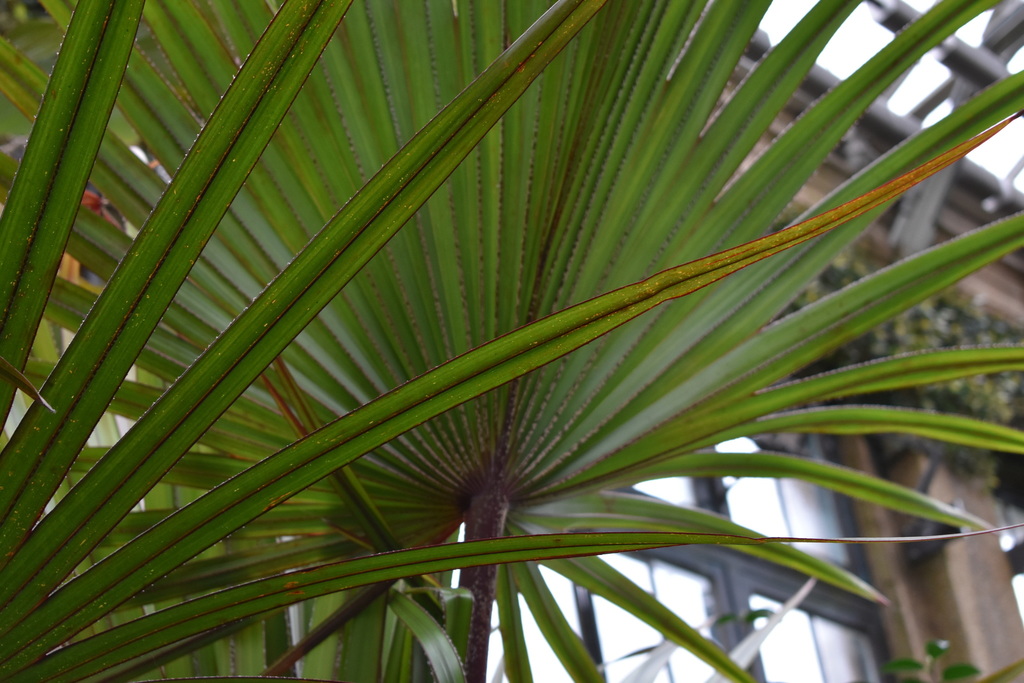
Quick facts
- Family: Arecaceae
- Difficulty: Moderate care
- Watering: every 7 days
- Light: Full sun
- Temperature: 15–40 °C
About Red latan palm
Latania lontaroides, commonly known as Red Latan Palm or Latanier de la Réunion, is a spectacular and slow-growing palm endemic to Reunion Island. It is distinguished by its large, blue-green palmate leaves, which in young specimens feature striking reddish margins on the petioles and central midrib, giving it its common name. This palm is a magnificent choice for tropical gardens or as a solitary specimen in warm, frost-free climates, where its robust trunk and distinctive foliage can be appreciated in all their majesty.
Native range
Endemic to Réunion Island, in the Indian Ocean.
Care tips
This palm requires full sun for optimal growth, though it can tolerate some partial shade in very hot climates. Watering should be regular and abundant during warm months, reduced in winter, but always ensuring good drainage to prevent waterlogging. It prefers fertile, well-drained soils that are slightly acidic to neutral. A common mistake is attempting to grow it indoors or in cold climates, as it is not frost-tolerant and needs ample space to develop its large size.
How to save a dying Red latan palm
- Warning signs
- Small, yellowish new leaves or dry tips; stunted growth. Old leaves wilt and drop quickly.
- First aid
- Check drainage. Water deeply if soil is dry. Provide magnesium and potassium if chlorotic. Move to full sun if possible.
- What kills it
- Lack of direct sun and good drainage. Overwatering in heavy soils or lack of essential nutrients like potassium and magnesium.
- Can it be saved?
- Yes, if roots are not rotted and central trunk is firm. Responds well to soil and exposure correction.