Serapias cordigera
Care, watering, light and tips for Serapias cordigera on Floravia.
Quick facts
- Family: Orchidaceae
- Difficulty: Demanding
- Watering: every 7 days
- Light: Indirect light
- Temperature: 15–30 °C
About Serapias cordigera
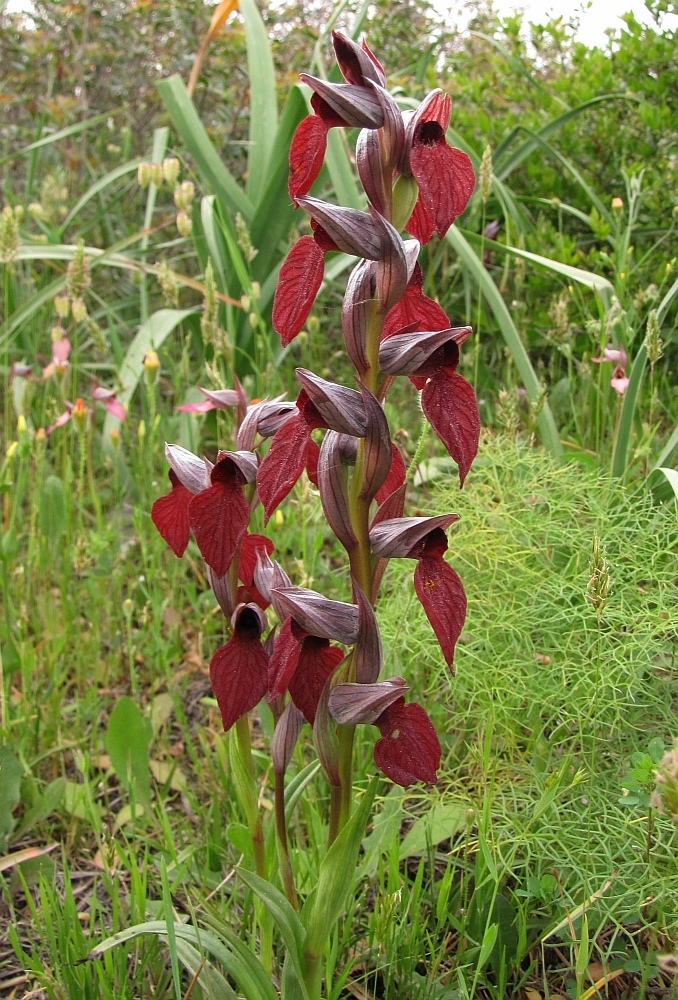
Serapias cordigera, commonly known as Heart-lipped Serapias, is a terrestrial orchid native to the Mediterranean region, valued for its peculiar flowers with a heart-shaped, dark purple or reddish labellum. Its floral bracts are notable and usually longer than the ovary, contributing to its distinctive appeal. It is an ideal plant for Mediterranean rock gardens or terrestrial orchid collections, where its spring bloom can be fully enjoyed.
Native range
Mediterranean region, from the Iberian Peninsula to Turkey and North Africa.
Care tips
It requires full sun to light partial shade and well-drained soil, preferably calcareous and poor in nutrients. Watering should be moderate during the spring growing and flowering period, reducing it drastically or suspending it during summer and autumn when the plant enters dormancy. Avoid excess moisture in the substrate, especially outside its active growing season, as this can lead to tuber rot. A common mistake is trying to cultivate it in pots with epiphytic orchid substrates; it needs a mineral and well-aerated substrate.
How to save a dying Serapias cordigera
- Warning signs
- Wilting or yellowing leaves, absent or weak flowering, rot at the stem base or roots.
- First aid
- Move it to a cool, semi-shaded spot. Check substrate: if soaked, let it dry; if dry, water moderately. Ensure good ventilation.
- What kills it
- Overwatering and poor drainage cause root and pseudobulb rot. Also, direct sun and extreme temperatures.
- Can it be saved?
- Yes, if rot hasn't affected the entire pseudobulb and roots. Act quickly to stop the disease's progression.